
Sources for Short Pump Previous Residents
A house-history search has several eras and several custodians. Current assessment and GIS records anchor the modern parcel. The Henrico Clerk's digital land-record system is strongest for the later deed trail, while the record room and Library of Virginia carry the work further back. Historical directories and newspapers can add household context, but their coverage is not a complete roll for rural or suburban Short Pump. Start with the source that fits the date question, then retain the exact wording and source citation for each result.
| Source | Years it covers | Where held | What it shows |
|---|---|---|---|
| Henrico assessment and GIS | Current publication | County property and map portals | GPIN or PID, situs, mailing line, physical and parcel context |
| Digital land records | 1947 forward | Henrico Circuit Court Clerk secure route | Recorded parties, date, instrument, legal description, plat references |
| Clerk record room and mail copies | Older and current material | Henrico Courts Building | Deeds, plats, instruments, and copy access |
| Henrico microfilm series | 1677 forward, series-specific | Library of Virginia VA125 | Deed books, selected indexes, court, probate, and reconstruction material |
| Richmond-area directories | 1819 to present holding description | Richmond Room and related collections | Printed household, business, location, and newspaper clues |
The county's public records and Clerk pages show the in-person and mail alternatives when a secure or online route cannot supply a needed record. Exact publisher-by-year Short Pump directory coverage was not located in the public library description, and no complete historic occupant list for a Short Pump parcel was found in the official research. Those are real gaps, not missing steps in a search.
Anchor a Short Pump Address
Begin with Henrico Property Search, using the full street number, prefix, street name, and unit. Save the GPIN or PID, stated situs, mailing address if shown, subdivision, lot, and legal-description language. The primary form visibly accepts those address and parcel fields, but did not show an owner-name input during the recorded inspection. A detail card may publish an owner field, yet an address search and a title conclusion are different tasks.
Next, use the Henrico GIS Viewer to identify the parcel, subdivision boundaries, lot, condo phase, and nearby parcel shapes. The map is reference-only and not a survey. It is still useful when a modern parcel was split, merged, or labeled differently from a deed. Keep the modern address beside the legal description. The address may change; the lot, plat, subdivision language, or metes-and-bounds description may be the better bridge into an older record.
Previous residents research should also preserve the distinction between situs and mailing addresses. A tax mailing line can belong to an owner, estate, trust, lender, or other party away from the physical Short Pump property. A parcel record is a strong starting point for the place, not an automatic account of every household.
Trace Short Pump Previous Residents
The deed trail is the backbone for ownership history. The Henrico Circuit Court Clerk keeps deeds, plats, wills, judgments, probate records, and other circuit materials. Starting from the current parcel, locate the most recent recorded conveyance and copy its grantor, grantee, recording date, document or instrument number, book and page, legal description, subdivision or lot, parcel reference, consideration wording when shown, and referenced plat. A deed links parties to a transaction. It does not, by itself, establish that each party lived at the property.
- Use the current property result to record the GPIN or PID, current physical address, lot or subdivision, and legal description.
- Search the current grantee and likely grantor in the Clerk's land-record path. Constrain a common name with date, document type, parcel reference, or legal wording.
- Open the conveyance, note its book/page or instrument reference, and identify the earlier grantor who transferred the property.
- Search that earlier party as a grantee in the preceding period. Compare the legal description rather than assuming the modern address stayed unchanged.
- When a record cites a plat, probate file, estate, or court order, follow that side record before declaring a missing ownership link.
- Grantor
- The party transferring an interest in a recorded instrument.
- Grantee
- The party receiving that interest in the recorded instrument.
- Chain of title
- The ordered series of recorded transfers used to trace an interest in the same property backward.
- Legal description
- The deed's parcel wording, such as a lot, plat reference, or boundary description, which can outlast an address change.
A trust, estate, corporation, duplicate name, or family transfer can look like a simple ownership change when it is not. Record the source and confidence of every link. That practice makes previous residents research reusable when an earlier document appears later.
Short Pump Records After 1947
Henrico says digitized land records reach back to 1947. That is an online-routing boundary, not the beginning of the property's history. Remote land-record access is a secure route with separate conditions. For public inspection and copies, the Clerk's record room remains the documented fallback. The land-record service also describes mail requests, and the Clerk's public location is the Courts Building at 4309 E Parham Road.
Use a deed's book/page or instrument reference to cross from the recent system to a paper, counter, mail, or archive channel. The Henrico land-record instructions describe recording and copy procedures, while the Henrico land-record portal also offers an optional title-alert service. That alert can report a future document recorded under a selected name. It is not a title opinion and does not replace a historical index search.
Open the county's land-record source page before relying on a recent deed route. 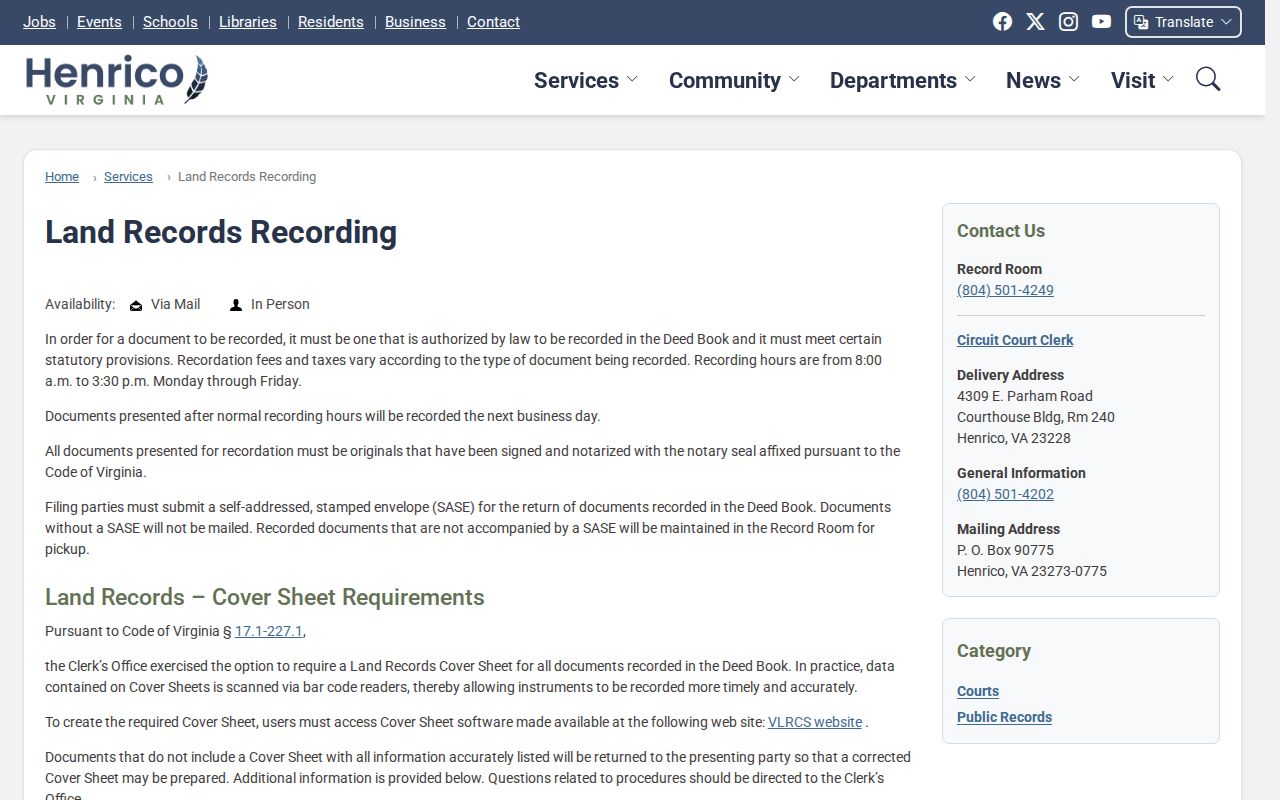 The Clerk's online, counter, and mail paths are different access channels for the same type of recorded material, so the image should be read with the current instructions.
Note: Verify copy charges and access conditions with the Clerk before sending a request, because published fee schedules can change.
Read Short Pump Directory Clues
The Richmond Public Library Richmond Room is the main locally described shelf for city and suburban directories, phone books, newspapers, yearbooks, maps, archives, and ephemera. Its public collection description dates city and suburban directories from 1819 to the present, but does not verify a complete Short Pump run. Because historic Short Pump was rural Henrico, an entry may be filed under a nearby road, post office, community, or postal wording rather than the modern community name.
The Library of Virginia identifies John Maddox's 1819 Richmond directory as the first named Richmond city directory, with the next edition not appearing until 1845. The 1819 entries often use relationships to streets and landmarks rather than today's house numbers. For an earlier address, copy the printed street, business, surname, spouse or widow wording, occupation, nearby cross street, page, and edition. Do not silently modernize a spelling.
Ask Richmond Room staff specifically about reverse, telephone, or householder-by-address volumes. The research did not locate a public title list for those volumes, so a particular year or address-first run must be confirmed with staff. The Short Pump Directory Book covers the collection methods in greater detail without turning a single address trail into a general directory search.
Pair Short Pump Past Households
Ownership and residence are separate evidence tracks. Once a deed gives a date and a property description, use the closest available directory edition for a household or business lead. Then pair that entry with the appropriate census material, newspaper notice, obituary, school record, cemetery source, or probate file. A directory record can show a listing at a point in time. It does not prove title, legal residence, or that every person at an address was printed.
- Write the deed year, legal description, and address wording as it appears in the source.
- Check the closest directory year for the address, surname, occupation, business, spouse wording, nearby road, and adjacent entry.
- Use the corresponding census era and library databases to test household composition and community context.
- Search newspapers or obituaries with the surname, location, spouse, cemetery, and date when a household appears to leave the address.
- Keep both hits and negative results, including a directory year that was searched but did not list the address.
Henrico County Public Library points researchers toward HeritageQuest, while Virginia residents have an Ancestry Library Edition route through the Library of Virginia arrangement. The county genealogy page also directs researchers to the Library of Virginia, historical society, and cemetery resources. These sources can clarify a family or former household connection without claiming that a modern address search produces a full resident history.
Short Pump Probate Side Trails
A deed chain can appear to jump when a property passed through an estate, trust, guardianship, court order, or family transaction. The Circuit Clerk service list includes wills, probate, judgments, court orders, marriage licenses, and name changes alongside land records. In a hard-to-explain gap, note the names and legal description from the last clear deed, then check whether probate, chancery, guardianship, or a referenced court record accounts for the change.
The Library of Virginia's Henrico locality series lists deed books and selected grantor/grantee indexes as well as wills, fiduciary records, guardians' accounts, ended chancery causes, and order books. Each series has its own survival period. A court or probate reference can add family context to a transaction, but it should be recorded as a side trail, not substituted for the conveyance itself.
Short Pump's 1865 Records Gap
Almost all Henrico circuit-court records were destroyed in the 1865 fire. A missing file may therefore reflect loss rather than a missing person, transaction, or household. The Library of Virginia documents surviving deed, will, chancery, order-book, guardianship, register, and newspaper paths that can sometimes reconstruct a family or property from another angle. The gap should be named in research notes along with the replacement series used.
Henrico's historic record trail is also uneven before the fire. Many records before 1677 are missing, while LVA has deed-book periods beginning in 1677 and a 1774 to 1782 reconstruction series. Will indexes reach back to 1781 in the county's digitization history. A modern GPIN should not be forced onto those early eras. Search locality, deed book, spelling, road, and legal language appropriate to the record instead. This is an important historical limit on claims about previous residents.
Short Pump Previous Residents Limits
Records can establish a property connection without proving that someone lived there, and a household listing can establish a dated clue without proving ownership. Postal labels, tax mailings, directory listings, census entries, and cemetery records each answer narrower questions. Short Pump, Glen Allen, Henrico, and Richmond wording can also overlap in old and current records. Retain the source's community and address language instead of replacing it with a preferred modern label.
Virginia FOIA is a route to an existing county record subject to exemptions, not a request for Henrico to build a personal-history list. The law calls for a written response within five working days, subject to its terms. When a source is missing, list the archive, shelf, time period, and search terms checked. An explicit gap is more useful than an invented former household.