
Short Pump City Directory Holdings
Short Pump is a Henrico County community rather than an incorporated city with its own clerk or archive. Its city-directory trail therefore begins with Richmond-area repositories and expands through county, state, and society collections. The Richmond Room describes a shelf of Richmond city and suburban directories from 1819 to the present. That wording matters: historic Short Pump was rural Henrico, so a useful entry may be filed under a nearby road, post office, or community name instead of the modern Short Pump label. Confirm individual volumes with staff before treating a shelf description as proof of a full Short Pump run.
| Collection | Years | Where Held | Access |
|---|---|---|---|
| John Maddox, The Richmond Directory, Register, and Almanac | 1819; next edition in 1845 | Library of Virginia | Library collection; Richmond focus |
| Richmond city and suburban directories | 1819 to present, as described by the library | Richmond Room | Non-circulating, browse while open; fragile items may need an appointment |
| U.S. City and Business Directories | About 1749 to 1990 | FamilySearch | Digitized collection; locality and year availability vary |
| Henrico locality microfilm | Series-specific material from 1677 onward | Library of Virginia | Microfilm and archival research; documented gaps apply |
The public descriptions do not list each directory publisher, title, or Short Pump year. Treat that absence as a reason to ask for the volume, not as a missing household. Most Richmond Room materials can be browsed while the room is open, with staff direction for scans or photographs.
Short Pump Directory Clues at Richmond Room
The Richmond Room is more than a row of directories. Its local-history holdings include Richmond-area telephone books, newspapers, yearbooks, maps, city archives, annual reports, ordinances, organizational records, and about 1,500 ephemera files. Materials do not circulate. That makes an in-person visit or an appointment the normal fallback when a digital search comes up short. The room also points researchers toward Virginia Chronicle, NewsBank, HeritageQuest, and in-library Ancestry Library Edition access.
An entry in a printed volume is stronger when its setting can be checked. Pair a street wording with a map, a phone book, a newspaper notice, or a yearbook from the same period. Note the directory title, publication year, page, and original wording before comparing it to a modern address. This preserves a trail that another family researcher can reproduce.
Note: Richmond-focused holdings can illuminate Short Pump history, but they do not create a complete rural Henrico household list.
Short Pump Before Numbered Streets
The Library of Virginia account of John Maddox's 1819 directory provides a warning for early searches. It identifies that volume as Richmond's first city directory and says the next edition was not issued until 1845. Its introduction described locations by streets and landmarks because the modern house-number system was not yet in place. A contemporary Short Pump road should not be forced onto an early listing that uses a crossroads, tavern, church, school, or nearby feature.
This local naming pattern has an extra wrinkle. Henrico says Short Pump grew around a tavern and stagecoach stop near a well with a notably short handle, in the Broad Street Road and Three Chopt Road area. A historical search can test those supported road and landmark terms, while keeping the printed source wording intact. The result may explain an address description, but it is not a substitute for the original volume.
Read a Short Pump City Directory Entry
Read each Short Pump city directory entry as a compact record, not a modern profile. The entry may give a name, a business or occupation label, a street or location description, and markers about a spouse, widowhood, boarding, or ownership where the publisher printed them. The 1819 example shows why a house number cannot be assumed. Copy unusual spellings rather than silently correcting them, and preserve the page or image reference with the title and year.
| Printed identity | Surname, given name, initials, and any spelling variant exactly as printed. |
|---|---|
| Business or occupation | A descriptive clue that can distinguish two names and guide a newspaper or deed search. |
| Location text | Street, road, house number, room wording, or a landmark-based description. |
| Household marker | Spouse, widow, boarder, or ownership notation when the volume includes one. |
| Source reference | Directory title, publisher if shown, year, page or image, and repository. |
- Criss-cross directory
- A street-order directory that can list a householder or subscriber by address. The public Richmond Room description does not confirm a separate run, so ask staff about a year and title.
- Householder index
- An index organized around the named person responsible for a listed address, rather than every person connected with a place.
- Abbreviation key
- The publisher's guide to shortened words and symbols. Photograph or transcribe it before interpreting entries.
Short Pump Names Beyond Directories
When a Short Pump city directory does not reach far enough, the Henrico Historical Society genealogy resources offer a different starting point. The society describes a transcription of the 1679 Henrico Tithe List as the only known extant Henrico tithe-list transcription from the 1600s and recommends using it with early land grants. It is a historical name source, not a current roll, but it can supply a family or locality lead for deeper archival research.
The society also directs researchers to the Library of Virginia, the 1950 census, and the Henrico Notable Henricoans Database. For Black family and community history, its guidance points to the Greater Richmond Afro-American Historical & Genealogical Society, Virginia Chronicle, and other archives. A gap in a mainstream city directory is not proof that a person or community was absent. Use the source that preserves the relevant historical context.
The image below comes from the Henrico Historical Society genealogy resource.
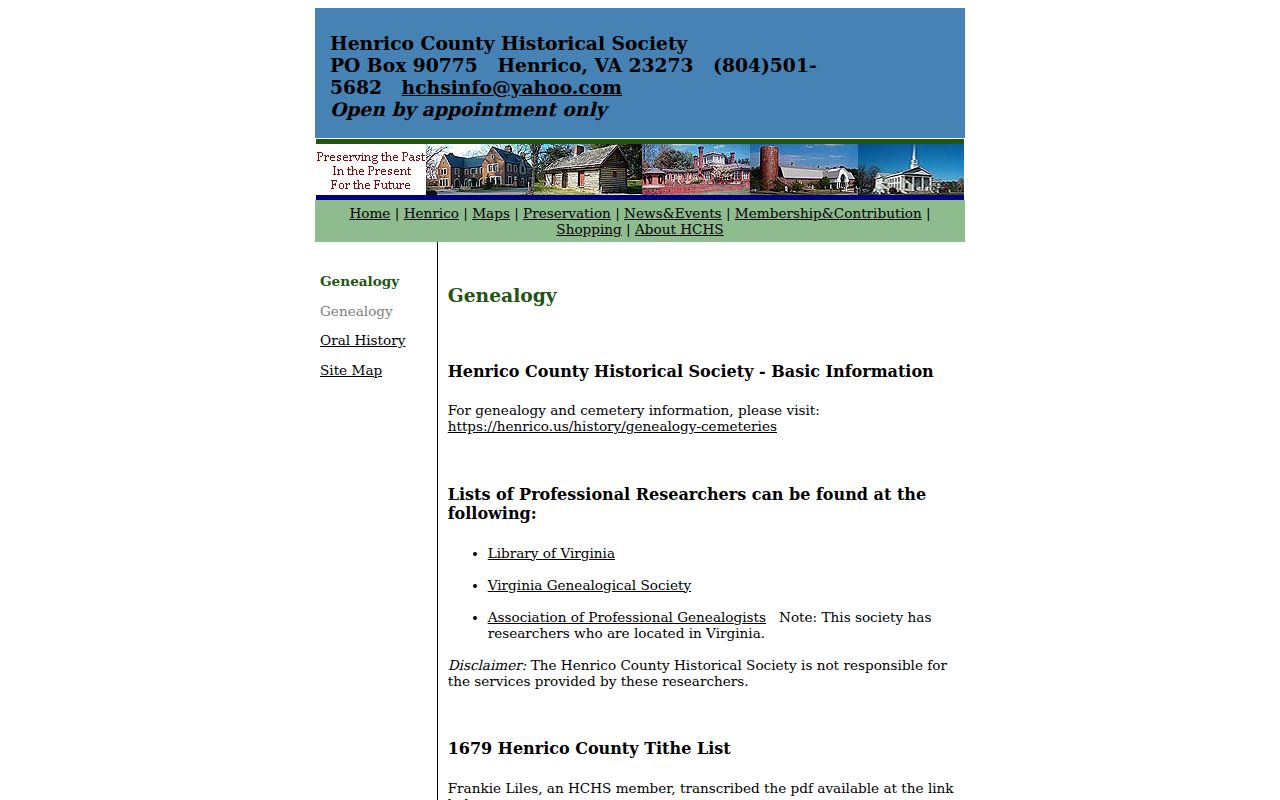
The society's genealogy material gives a Short Pump directory search a documented path beyond the city-directory shelf.
Short Pump Directory Gaps by Era
The Library of Virginia Henrico locality microfilm guide is the right next stop for earlier county records. It lists deeds, grantor and grantee indexes, colonial material, common-law order books, chancery causes, wills, fiduciary records, guardians' accounts, and other series. Those records are not directories, but they can anchor a name or property when the printed shelf is thin. Series dates and survival differ, so use the guide's individual record descriptions rather than expecting one continuous household trail.
Henrico's modern Clerk digitization reaches land records back to 1947 and will indexes back to 1781, while older material remains a library and archive task. The useful sequence is directory clue, deed or probate check, then microfilm series when a record trail reaches beyond the web. A modern parcel identifier does not belong in a colonial search.
Short Pump Records After 1865
Henrico's record trail is uneven. The Library of Virginia reports major losses before 1677, destruction during the Revolutionary War, and the loss of almost all circuit-court records in the 1865 fire. A missing court file can therefore reflect a loss rather than an absent person, family, or transaction. It is more accurate to document the gap and look for a surviving series than to claim that an online or shelf search settled the question.
| Period | Directory or record landmark | Search response |
|---|---|---|
| 1819 | First named Richmond city directory; addresses could be landmark-based | Search roads, landmarks, and spelling variants alongside names. |
| 1865 | Most Henrico circuit-court records were destroyed by fire | Check deeds, probate, chancery material, and newspapers for substitutes. |
| 1947 onward | Henrico reports digitized land records from this point | Use Clerk and record-room channels for a recent deed trail. |
Short Pump Directory Companion Sources
A city directory is one dated observation. Richmond Room newspapers can add an obituary, notice, or community reference, while phone books, maps, and yearbooks help test whether a road, school, or institution fits the same period. Search newspapers with a surname plus an address, spouse, cemetery, or business term. Record the newspaper title, issue date, page or image, and whether the item is a notice or an obituary.
For a rural Short Pump question, maps and local landmarks can be valuable. The Henrico GIS Viewer shows current parcel and subdivision relationships, while old maps and the Richmond Room map shelf may clarify a road or institution named in an older entry. Exact Short Pump coverage in urban fire-insurance maps was not located, so an absent sheet does not establish that a building or family was absent.
Trace Short Pump Households Through Directories
Use Short Pump city directories to form a dated sequence, then test the sequence against records held by the proper custodian. Start with the latest known appearance and work in both directions. A person who disappears may have moved, died, changed a name or business description, or simply been omitted. The next source should be chosen for the question at hand, rather than treating a directory line as final proof of residence or ownership.
- Locate the closest known directory year and capture the title, page, spelling, address wording, and each printed household clue.
- Search the preceding and following editions with spelling variants, occupation wording, spouse or widow markers, and nearby roads.
- Ask the Richmond Room whether a street-order or reverse volume exists for that period, then record any householder result exactly as printed.
- Pair a directory year with the appropriate census, deed, newspaper, cemetery, yearbook, or vital-index source to test the lead.
- When an address becomes important, use the modern Short Pump street directory route for the current parcel and address-record workflow.
Keep the negative result as well. A documented missing year, a rural coverage limit, or a fire-related record loss explains why a clean year-by-year trail may not exist.
Note: A directory entry records a listing at a particular time, not conclusive proof of ownership, legal residence, or every occupant.